
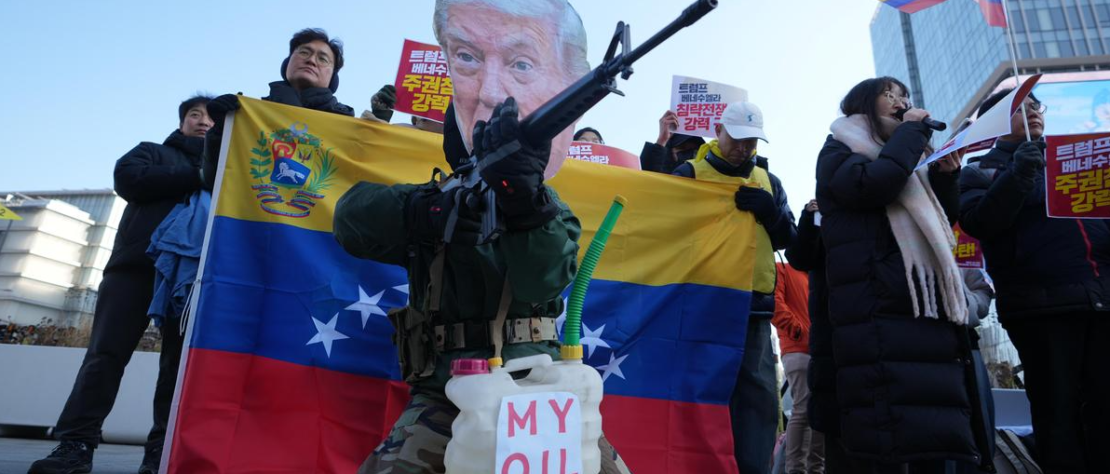
The ongoing geopolitical tension between the United States and Venezuela has reached a critical point after the U.S. military captured Venezuelan President Nicolás Maduro in a bold raid in Caracas. The UN Security Council is set to convene an emergency session on January 5, 2026, at Venezuela’s request to address the escalating crisis.
Key Developments in U.S.-Venezuela Conflict
U.S. Captures Venezuelan President Nicolás Maduro
On January 3, 2026, U.S. forces launched a pre-dawn operation in Caracas, resulting in the capture of Venezuelan President Nicolás Maduro and his wife, Cilia Flores. Maduro was transported to New York to face federal charges including narcoterrorism linked to alleged cocaine trafficking into the United States.
Maduro is scheduled to appear before a federal judge in New York on January 5 to be formally notified of the charges.
Interim Venezuelan President Delcy Rodriguez Forms Release Commission
Following Maduro’s capture, Venezuela’s interim President Delcy Rodriguez convened her first cabinet meeting and established a commission to negotiate the release of Maduro and his wife. Rodriguez called for cooperation with the U.S., aiming to prioritize “balanced and respectful relations” between the two nations despite the crisis.
President Donald Trump’s Warning and Claims
U.S. President Donald Trump asserted that the United States is “in charge” of Venezuela after Maduro’s seizure. Trump also warned that acting President Delcy Rodriguez may face harsher consequences than Maduro if she refuses to cooperate with U.S. demands. Furthermore, Trump hinted at possible further military operations in the region, including against Colombia.
International Reactions and Regional Impact
UN Security Council Emergency Meeting
The UN Security Council will meet urgently on January 5 to discuss the legality and implications of the U.S. military action in Venezuela. Several countries, including China, Russia, and Iran, have condemned the U.S. operation, calling it illegal and destabilizing.
China and Russia’s Stance
- China: Urged the immediate release of Maduro and condemned the U.S. seizure as a violation of sovereignty. Chinese financial regulators are also monitoring their banks’ exposure to Venezuela amid rising geopolitical risks.
- Russia: Called the U.S. military action unlawful and a destabilizing move in Latin America.
Regional Protests and Political Fallout
- Pro-Maduro supporters held rallies in Caracas demanding his release.
- The Communist Party of India (Marxist) attempted to stage a protest outside the U.S. Consulate in Chennai, India, but were stopped by police.
- Greenland’s Prime Minister Jens Frederik Nielsen condemned President Trump’s repeated threats against Greenland.
Economic and Market Impact
Defense Stocks Surge in Europe
European defense companies saw shares rise sharply following the U.S. military action in Venezuela. Key aerospace and defense stocks in Germany, Italy, Sweden, Spain, and the UK rallied, driven by increased geopolitical tensions.
Oil and Commodity Markets
- Oil prices showed mixed reactions; initial gains gave way to modest declines amid uncertainty about Venezuela’s oil output.
- Gold and other precious metals surged to one-week highs due to safe-haven demand amid geopolitical instability.
Venezuela’s Oil Production Outlook
Despite current turmoil, analysts forecast a gradual recovery in Venezuela’s oil production, which could eventually depress global oil prices. Production may rise from about 800,000 barrels per day to potentially 2.5 million barrels per day over the next decade with sufficient investment.
Casualties and Human Cost
The U.S. strike reportedly killed a significant portion of Maduro’s security team along with military personnel and civilians. Cuba confirmed the deaths of 32 Cuban officers who were assisting Venezuela’s security forces.
Summary
The U.S. capture of Venezuelan President Nicolás Maduro marks a major escalation in U.S.-Venezuela tensions, triggering widespread international condemnation and fears of further instability in Latin America. The UN Security Council’s emergency session on January 5 will be a critical moment for diplomatic efforts, while markets and governments worldwide closely watch unfolding events.