
A Stadium Moment for the Ages
In the glittering lights of Levi’s Stadium, where Lady Gaga once delivered a soaring national anthem a decade earlier, the Apple Music Super Bowl LX Halftime Show delivered its most unforgettable moment on February 8.
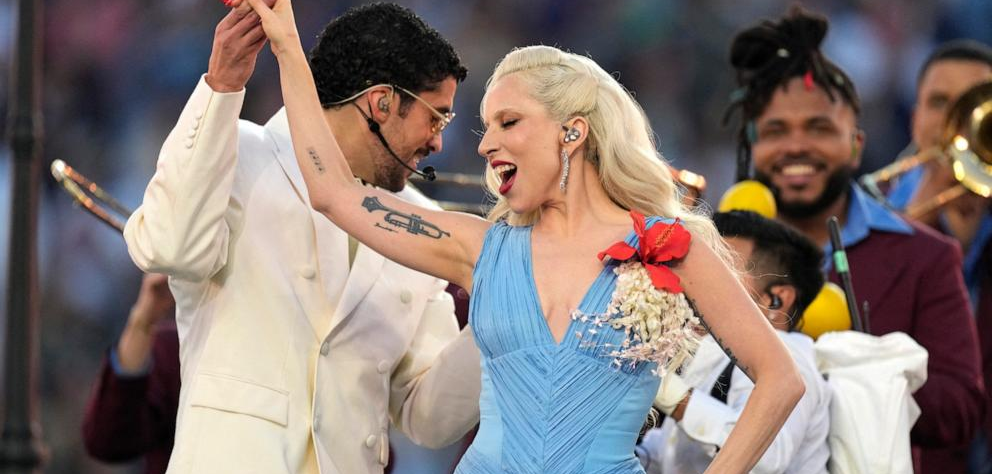
Midway through Bad Bunny’s groundbreaking set, the first Super Bowl halftime performance delivered almost entirely in Spanish, Lady Gaga emerged like a vision from an elevated platform during a staged Puerto Rican wedding scene. Dressed in a striking baby blue gown with red heels and a bold floral accent, she transformed her 2024 hit Die With A Smile into a vibrant, rhythm-driven salsa explosion, backed by dancers and the legendary group Los Sobrinos.
“It felt less like a guest appearance and more like a cultural coronation,” one industry executive observed moments after the performance.
The crowd erupted. Gaga and Bad Bunny danced with effortless chemistry, transitioning seamlessly into his track Baile Inolvidable. Social media ignited instantly with clips of the duo grooving together, fans hailing it as the standout highlight of a night already packed with Puerto Rican pride, celebrity cameos including Ricky Martin, and themes of unity.
An estimated 125 to 135 million viewers tuned in worldwide, making this one of the most-watched halftime shows in recent memory.
Reinventing a Modern Classic
Die With A Smile began as a 2021 sketch by Bruno Mars, who toyed with themes of apocalyptic romance, holding onto love even as the world ends. He shelved the demo until 2024, when he played its core ideas for Gaga in his Malibu studio. The pair finished writing and recording the song in a single marathon night, capturing a timeless, 1970s-inspired ballad that became a massive global hit and climbed high on the Billboard Hot 100.
Sunday’s performance marked a radical reinvention.
Bad Bunny’s team transformed the intimate piano ballad into an upbeat salsa anthem, infusing it with Latin percussion, brass flourishes, and choreography reminiscent of Puerto Rican street celebrations. It was more than a musical remix. It was a symbolic bridge, a mainstream English-language pop staple reimagined through a Boricua cultural lens on America’s biggest stage.
“That was not adaptation. That was translation,” noted a Latin music producer watching from Miami.
Gaga, long celebrated for her stylistic range, proved her versatility once again. Her confident salsa phrasing and visible joy recalled her commanding 2017 Super Bowl LI performance while revealing an artist still eager to explore new forms.
Grammys, Respect, and Perfect Timing
The moment carried extra resonance following the 2026 Grammy Awards just days earlier, where Gaga publicly embraced Bad Bunny after his historic Album of the Year win for Debí Tirar Más Fotos, the first Spanish-language album to claim the top honor.
Their playful on-camera interaction, including a lighthearted “scare” hug, hinted at genuine mutual admiration. Sunday’s surprise appearance felt like a natural continuation of that moment, two global icons celebrating one another while spotlighting Latin roots on the world’s largest entertainment stage.
A Love Letter to Puerto Rico
Bad Bunny’s entire 13 to 14 minute halftime production functioned as a tribute to Puerto Rico. The casita-style set evoked island homes, while vignettes depicted farmers, domino players, and bomba and plena dancers. Ricky Martin’s appearance carried subtle references to post Hurricane Maria struggles and ongoing infrastructure challenges.
Bad Bunny closed the show with a clear and deliberate message.
“Together, We Are America.”
He named countries across the continent and waved the pro-independence Puerto Rican flag in an unapologetic gesture that resonated far beyond the stadium.
For Puerto Rico, a U.S. territory often marginalized in mainland narratives, the performance became a national moment. Islanders reportedly paused daily life to watch. Conversations around identity, citizenship, and resilience surged across social platforms.
In Latin America, Spanish-language broadcasts saw dramatic viewership spikes, drawing audiences who might otherwise skip the NFL entirely. For viewers in the UK and Europe, the show underscored Latin culture’s expanding influence within American entertainment.
The choice of Levi’s Stadium, the same venue where Gaga sang the national anthem in 2016, added poetic symmetry, connecting past NFL spectacles to a more inclusive future.
The Business of the Beat
Beyond cultural symbolism, the economic impact is expected to be substantial.
Historically, Super Bowl halftime performances generate streaming increases of 100 to 400 percent or more for featured artists. Die With A Smile, already a catalog favorite, is poised for renewed chart momentum, while the salsa version is likely to spark remixes, covers, and TikTok trends.
Bad Bunny’s broader catalog stands to benefit as well, alongside Puerto Rican tourism. His previous island residency generated an estimated $200 million in direct economic activity.
Regionally, early projections for Super Bowl LX estimate between $370 million and $630 million in direct economic output for the Bay Area, driven by tourism, hospitality, and event-related spending. Apple Music’s approximately $50 million annual sponsorship of the halftime show reinforces its value as a marketing powerhouse.
The performance also reflects broader industry trends. Latin music continues its ascent as a commercial force, and Bad Bunny’s headlining slot signals the NFL’s strategic push into global and Hispanic markets where viewership and merchandise growth remain strong.
Why This Halftime Will Endure
Lady Gaga’s salsa-infused appearance was not merely a surprise cameo. It was a case study in cultural fusion at a time when entertainment increasingly mirrors evolving demographics.
Pop nostalgia met Latin innovation. English-language hits shared space with Spanish-stage dominance. Individual star power elevated collective pride.
“This was joy as statement,” said one longtime halftime producer. “And it worked.”
In an era often defined by division, Bad Bunny and Gaga delivered a performance rooted in celebration and inclusion. A ballad about enduring love became a salsa anthem of cultural endurance.
The world danced along. In doing so, it glimpsed an America expansive enough to hold all its voices.
As senior editor covering entertainment’s most consequential stages, one conclusion is clear. Moments like this do more than entertain. They reshape the conversation.
What a night for music. What a night for Puerto Rico. And what a reminder of the enduring power of surprise.