
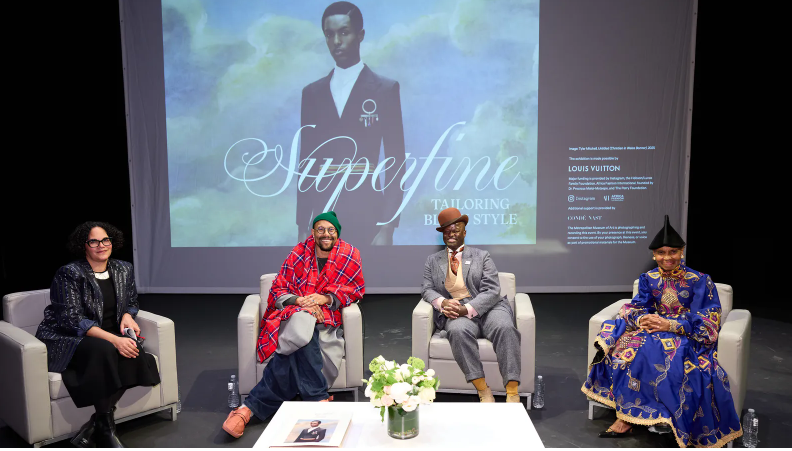
As the fashion world eagerly awaits the 2025 Met Gala, Harlem has taken center stage in a conversation that’s as stylish as it is culturally profound. On a brisk April evening in New York City, tastemakers, scholars, and creatives gathered at The Apollo Stages—an extension of the iconic Apollo Theater—for a powerful panel discussion exploring Harlem’s lasting influence on Black fashion, art, and identity.
Hosted inside the Victoria Theater, the event was part of a lead-up to the Met Gala’s spring exhibition titled “Superfine: Tailoring Black Style,” which will open at The Metropolitan Museum of Art’s Costume Institute. The talk, moderated by Monica L. Miller, Ph.D.—professor and chair of Africana Studies at Barnard College and guest curator of the exhibit—offered a moving tribute to Harlem’s role as the epicenter of Black creativity and sartorial expression.
Harlem as a Portal of Style
“Harlem serves as a creative portal,” said Dr. Miller, setting the tone for the evening. She described the Black dandy not just as a figure of fashion, but as a symbol of resistance, aspiration, and reimagination. Images from the forthcoming exhibition flashed on screen: a bold Harlequin-printed ensemble by Tremaine Emory of Denim Tears, and a vintage portrait of Frederick Douglass dressed in crisp tailoring—each piece a testament to Black excellence in fashion.
A Panel Rich in Perspective
Joining Dr. Miller onstage were Jonathan McCrory, executive artistic director of the National Black Theatre; fashion historian and icon Lana Turner; and musician and style connoisseur Dandy Wellington.
McCrory captivated the audience with a poetic take on Black male dandyism, likening it to the metamorphosis of a caterpillar into a butterfly. “Our clothing allows us to create protection to be radically soft in a brittle world,” he shared, earning a round of applause. For McCrory, fashion is more than aesthetic—it’s armor, expression, and reclamation.
Turner, whose parents were part of Harlem’s fashionable 1950s and ’60s heyday, painted a vivid picture of a time when strolling down Seventh Avenue was akin to a Parisian runway. “He always cut a dashing figure,” she said of her father, recalling his signature Stetson hat and polished shoes. Though he worked as a chauffeur, he dressed like an executive—a statement of pride, dignity, and hope.
Wellington brought the conversation full circle, highlighting the innovation born from limitation. “Black people have always remixed, sampled, and transmogrified fashion,” he said. “My style is an echo of the past, but also a portal to the future.” His words underscored the creative resilience that has always defined Black fashion.
A Preview of What’s to Come
The event concluded with a Q&A, where audience members expressed excitement for the upcoming exhibit. “I can’t wait to see how the exhibition tells the story of Black dandyism through time,” said attendee Rachel Francois. “I want to understand what it meant for people to show up and show out—especially when the world wasn’t always watching.”
Reflecting on the journey from page to exhibition, Dr. Miller—whose 2009 book Slaves to Fashion: Black Dandyism and the Styling of Black Diasporic Identity inspired the Superfine exhibit—shared her personal pride. “I didn’t anticipate a book I wrote 15 years ago would become a 3D experience,” she told Vogue. “I feel honored and responsible to do the subject justice.”
As guests stepped back out into the chilled Harlem night, beneath the glowing marquee of The Apollo, the legacy of Uptown elegance and expression remained palpable. The 2025 Met Gala may be months away, but its spirit is already alive—and it’s dressed to impress.