
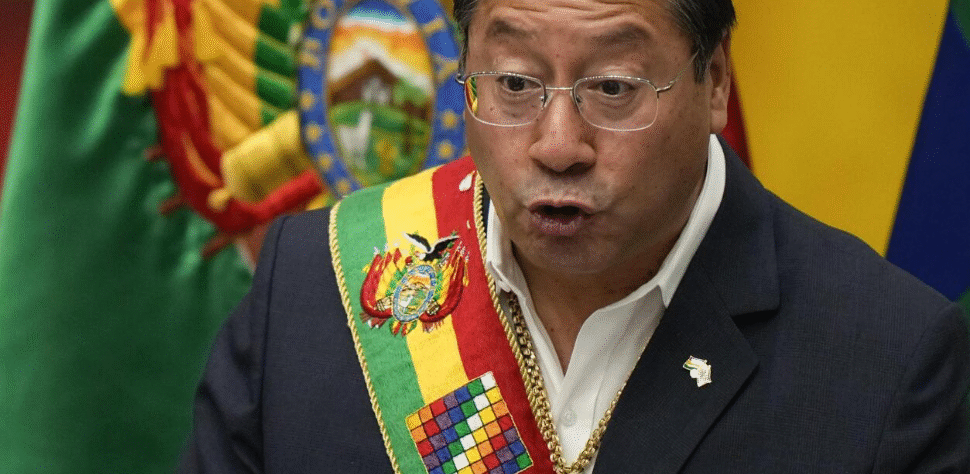
Former Bolivian President Luis Arce has been detained by police amid an ongoing investigation into alleged embezzlement during his tenure as Economy Minister under former President Evo Morales, according to statements from former cabinet members and local media reports. The detention has sparked widespread concern over possible political motivations, given the recent shift in Bolivia’s government.
Arce, who stepped down from office last month following the presidential election, may have been called in to testify in relation to a probe into the alleged misappropriation of state funds. Maria Nela Prada, a former minister in Arce’s cabinet, told reporters that the former president had been detained without prior notification or a formal summons.
“Of course he’s innocent. This has been a total abuse of power,” Prada said. “We hope this case is not being taken as an opportunity to carry out political persecution.”
Prada emphasized that Arce had not been formally ordered to appear before authorities, and that police reportedly “simply took him.” Reuters was unable to independently verify Arce’s current location at the time of reporting.
Local media reports indicate that Arce was detained by Fuerza Especial de Lucha Contra el Crimen (FELCC), a specialized Bolivian police force. FELCC has not responded to requests for comment regarding the detention.
The investigation focuses on alleged misappropriation of state funds intended to finance development projects for Indigenous communities. According to reports, investigators claim that evidence links Arce to irregularities in the allocation and management of these funds. The specifics of the alleged embezzlement remain unclear, though authorities suggest it involves substantial sums disbursed during Arce’s period as minister.
The timing of Arce’s detention comes amid a major political transition in Bolivia. In October, centrist candidate Rodrigo Paz won the presidential runoff election, ending nearly two decades of dominance by the leftist MAS party, which Arce represented. Paz has made tackling corruption within state institutions a central pillar of his administration, promising stricter oversight and legal action against alleged mismanagement of public resources.
Political analysts caution that the detention of Arce, a prominent figure in Bolivia’s leftist political sphere, could inflame tensions in the country. “This is a delicate situation,” said political commentator Juan Carlos Fernandez. “On one hand, the investigation into embezzlement is legitimate. On the other, any perception of targeting former leaders for political reasons could deepen divisions.”
The MAS party has condemned the detention. In a statement, the party described the move as “an attack on democracy and an attempt to intimidate political opponents.” Party officials also called for due process and transparency in the investigation, emphasizing that Arce should be presumed innocent until proven guilty.
Luis Arce, a former economist who served as Bolivia’s Minister of Economy from 2006 to 2017 before becoming president in 2020, is known for his role in stabilizing Bolivia’s economy during Morales’ presidency. He left office amid growing public discontent and political polarization, which intensified during the October elections.
Observers are closely monitoring developments, as the case has implications not only for Bolivia’s political landscape but also for international perceptions of governance and rule of law in the country. Human rights groups and international organizations have called for fair treatment of Arce, urging Bolivian authorities to ensure transparency and respect for legal procedures.
As of now, it remains unclear whether Arce will be formally charged, released pending further investigation, or face detention for an extended period. Authorities have indicated that further details will be released once the investigation progresses.