
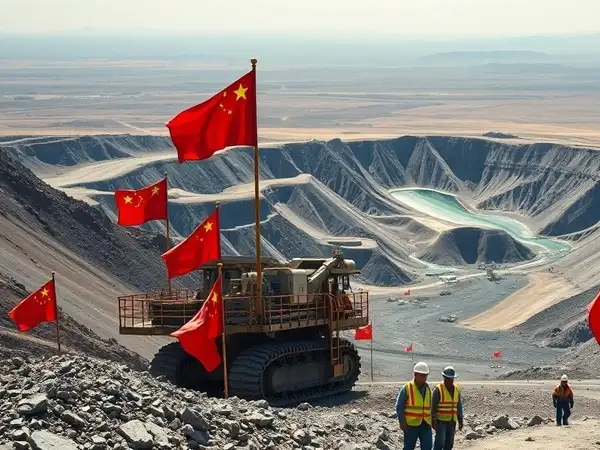
China has introduced a new mining initiative with a group of “friendly nations” at the G20 Leaders’ Summit in Johannesburg, signalling a shift in the global conversation around critical mineral supply chains.
Announced on Sunday by Chinese Premier Li Qiang, the plan aims to promote “mutually beneficial cooperation and the peaceful use of key minerals,” while protecting the interests of developing countries and carefully managing minerals with potential military applications.
The initiative — launched at Africa’s first-ever G20 summit — includes 19 participating countries, among them Cambodia, Nigeria, Myanmar and Zimbabwe, alongside the United Nations Industrial Development Organisation (UNIDO). Beijing has not yet disclosed any financial details.
Chinese state media described the proposal as an effort to build an inclusive global network to ensure the “fair, reasonable, stable and smooth” extraction and processing of critical minerals.
Global Push for Secure Mineral Supply Chains
The announcement comes at a time when Western nations and Global South economies are increasingly concerned about disruptions in access to essential minerals. China dominates global processing of rare earth elements, which are key to industries such as electronics, renewable energy and defence manufacturing.
The G20’s joint declaration earlier this week subtly criticised China, raising concerns about “unilateral trade actions” that restrict access to vital minerals — an ongoing challenge for manufacturing-led economies like Germany and Japan.
Why China Says Export Controls Are Necessary
In his address, Li Qiang defended China’s tightening of mineral export rules, arguing that controlling shipments of minerals with military relevance is a strategic safeguard.
China’s rare earth regulations, introduced in April and expanded in October, require exporters to obtain licences for every shipment. The new regime has already contributed to supply shortages, temporarily halting segments of the auto industry earlier this year.
Under President Xi Jinping, China has increasingly used its dominance in rare earths — vital for products ranging from smartphones to missile systems — as leverage in trade tensions, particularly during disputes with the United States.
Global Response and Future Negotiations
European nations, heavily dependent on imports of rare earth metals, have been hit hard by the licensing system. Leaders from France, Germany, the UK and Ireland are expected to visit China soon, with mineral access expected to be high on the agenda.
Meanwhile, Beijing and Washington are in the final stages of negotiating “general licenses” that would allow a freer flow of rare earths between the world’s two largest economies. The talks follow a recent trade truce between Xi Jinping and US President Donald Trump, which Trump claimed would bring stability to global markets.
China’s new initiative signals its intention to reshape mineral supply cooperation — but also comes as the world races to secure its own access to the critical materials powering modern technology.