
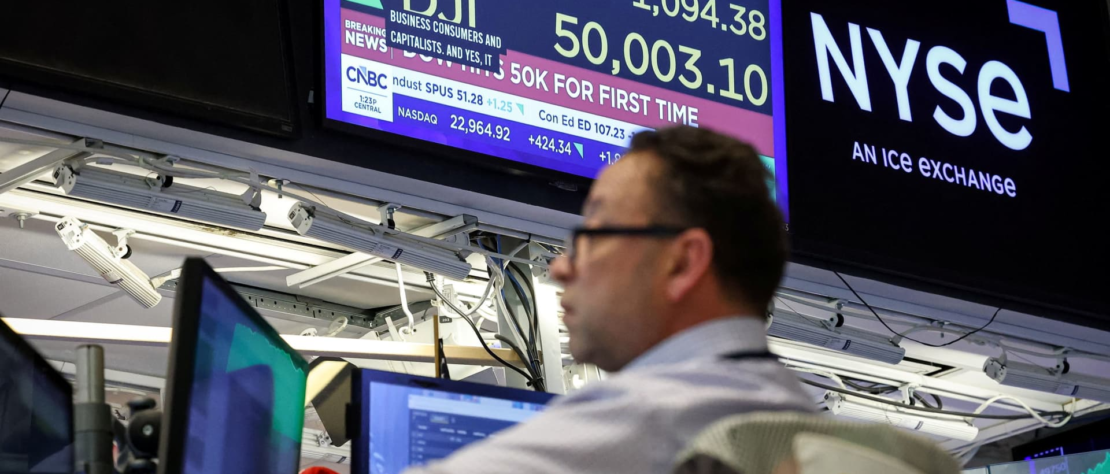
The Dow Jones Industrial Average crossed a symbolic and historic threshold on Friday, February 6, 2026, closing above the psychologically powerful 50,000 mark for the first time in its 130-year history.
In a dramatic rebound that reignited Wall Street’s confidence, the blue-chip index surged 1,206.95 points, or 2.47 percent, to finish at 50,115.67. It marked the Dow’s best single-day performance since May and delivered a forceful response to a bruising three-day sell-off in technology stocks.
On the floor of the New York Stock Exchange, traders erupted as screens flashed the milestone. Some donned celebratory “Dow 50K” caps as the closing bell rang.
“It wasn’t just another record. It was a statement of resilience from a market that continues to defy volatility.”
The rally underscored a market that has repeatedly absorbed geopolitical tensions, inflation fears, and warnings of an artificial intelligence bubble, yet continues to push higher.
From Railroads to AI: The Long Road to 50,000
First calculated in 1896 by Charles Dow and Edward Jones as a simple average of 12 industrial stocks, the Dow Jones Industrial Average has evolved dramatically from its origins tracking railroads, steel, and early manufacturing.
The index expanded to 30 constituents in 1928 and has undergone 136 changes to remain relevant. Its most recent reshaping came in late 2024, with the addition of Nvidia and Sherwin-Williams, signaling a clearer alignment with the AI-driven economy.
Major milestones have arrived with accelerating speed:
- 10,000 in March 1999 during the dot-com era
- 20,000 in January 2017
- 30,000 in November 2020 amid post-pandemic stimulus
- 40,000 in May 2024
The leap from 40,000 to 50,000 took between 431 and 630 trading days, making it the fastest 10,000-point climb in the index’s history.
“Successive round numbers require smaller percentage gains, but the pace still highlights an extraordinary bull market now entering its fourth year.”
A Different Dow, with Familiar Strengths
While the Dow remains price-weighted and limited to just 30 stocks, recent changes have increased its exposure to technology. Still, Friday’s surge was driven largely by the index’s traditional backbone.
Industrials and financials led the charge, offering a reminder that this is no longer a rally dependent solely on a handful of megacap technology names.
“This is not your great-grandfather’s Dow, but it is still powered by old-economy strength.”
What Powered the Breakthrough
Rotation, Earnings, and AI Infrastructure Demand
Friday’s rally followed a turbulent week marked by anxiety over AI-related capital spending. Concerns intensified after Amazon’s cautious AI infrastructure outlook rattled markets, raising fears of margin pressure and overinvestment.
Tech-heavy indices faltered. The Dow, less concentrated in the so-called Magnificent Seven, held firm and then surged.
Key contributors included:
- Caterpillar, which jumped more than 7 percent on the day and is up 27 percent year-to-date, boosted by demand for generators and heavy equipment used in AI data centers.
- Nvidia, which rebounded nearly 8 percent after recent losses.
- Goldman Sachs, which rose more than 4 percent.
Analysts pointed to a healthy sector rotation away from overheated technology stocks and toward cyclicals, financials, and industrials.
Broader fundamentals reinforced the move. U.S. consumer spending remains resilient, particularly among higher-income households. Corporate earnings have improved, and expectations are growing for Federal Reserve rate cuts later in 2026 as inflation continues to cool.
President Donald Trump praised the milestone on social media, crediting economic policy.
Market breadth strengthened, with the Dow outperforming both the S&P 500 and the Nasdaq in early 2026. Year-to-date, the Dow is up 4.3 percent, compared with 1.3 percent for the S&P 500 and a 0.9 percent decline for the Nasdaq.
Global Ripples from an American Benchmark
Though distinctly American, the Dow’s breach of 50,000 sent waves through global markets.
Asian equities, particularly in Japan, found support from a strong election outcome favoring policy continuity and growth. European markets opened higher in sympathy, while emerging markets saw tentative inflows as U.S. strength bolstered global risk appetite.
The global picture, however, remains complex. International equities outperformed U.S. stocks in 2025 and have led in parts of early 2026, reflecting more attractive valuations abroad amid elevated U.S. multiples.
A stronger dollar could pressure commodity exporters, and robust U.S. growth may draw capital away from developing economies. Geopolitical tensions involving Iran, transatlantic disputes, and developments in Latin America were largely brushed aside but remain underlying risks.
Wealth Effect Meets Real-World Caution
For investors, the milestone is unequivocally bullish. Retirement portfolios linked to major indices swelled, reinforcing the wealth effect that can lift consumer confidence and spending.
Corporations benefit from elevated valuations that support fundraising, acquisitions, and capital investment. The rally strengthens the narrative of a soft landing, solid growth without runaway inflation.
JPMorgan Chase CEO Jamie Dimon offered a note of caution.
“The U.S. economy has remained resilient. However, as usual, we remain vigilant, and markets seem to underappreciate the potential hazards, including complex geopolitical conditions, the risk of sticky inflation, and elevated asset prices.”
Critics also note the Dow’s limitations. It tracks just 30 stocks and disproportionately reflects the fortunes of wealthier Americans who own equities. Many households continue to face affordability pressures in housing, groceries, and daily expenses.
High valuations may constrain future returns, and any disappointment in AI productivity gains or corporate earnings could trigger sharp pullbacks.
Celebration or Inflection Point?
The Dow’s sprint to 50,000 reflects a market that has adapted to higher interest rates, rapid technological disruption, and shifting policy landscapes. Crucially, it highlights broader participation beyond a narrow group of technology giants.
Still, caution lingers.
“The market may have set a fairly high bar for itself,” said Morgan Stanley’s Daniel Skelly.
With valuations already pricing in optimistic AI-driven growth, volatility is likely as earnings reports and policy decisions unfold.
For now, 50,000 stands as both a celebration and a reminder. Markets climb walls of worry, evolve with the times, and reward patience. The story of the Dow Jones Industrial Average is far from finished, and its next chapter may be just as consequential.