
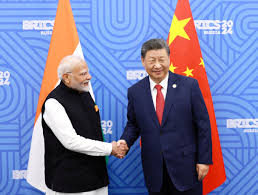
India is adopting a new approach to its complex relationship with China, a strategy experts describe as “managed rivalry.” Rather than severing economic ties abruptly, New Delhi is focusing on managing dependence on China while gradually developing alternatives.
When Prime Minister Narendra Modi and Chinese President Xi Jinping met in October 2024, followed by a limited border agreement, hopes of stabilizing ties briefly rose. Yet, a year later, tensions along the Line of Actual Control (LAC) remain. China continues to strengthen its military presence with all-weather roads, surveillance systems, logistics hubs, and border villages, while India maintains roughly 50,000–60,000 troops along the Himalayan frontier. Five years after the Galwan Valley clash, the border remains a zone of permanent tension.
At the same time, economic engagement between the two nations is cautiously resuming. Bilateral trade reached $128 billion in 2024, with India importing crucial goods such as electronic components, pharmaceuticals, industrial machinery, and renewable energy inputs. Sectors like electric vehicles, solar energy, drones, and electronics remain heavily dependent on Chinese inputs despite India’s push for domestic alternatives through Production-Linked Incentive (PLI) schemes.
India’s current approach emphasizes compartmentalization over decoupling: securing sensitive sectors, regulating Chinese investments, and fostering domestic alternatives, while allowing selective economic engagement where dependence is unavoidable. Partnerships with countries like the US, Japan, Taiwan, and Europe are being leveraged to diversify supply chains gradually.
This strategy reflects a delicate balancing act—maintaining military vigilance along the border while sustaining the economic inputs necessary for India’s growth and green-energy ambitions. The coming years will test whether India can successfully navigate strategic hostility and economic interdependence, creating a durable model of managed rivalry that may define India-China relations for the foreseeable future.