
From smart tools to robotic creativity, artificial intelligence (AI) is rapidly entering the art world. But after spending a year working with a robotic painting arm at the University of Konstanz, I can tell you firsthand: the AI art conversation is often more fiction than fact.
AI Painting Isn’t What It Seems
We’ve all seen the headlines—robots making art, AI generating masterpieces. But what people call “AI painting” is often just a printed digital file. The real complexity begins when machines interact with physical tools—like brushes and oil paint. And that’s where things get messy.
Working With a Robotic Painter
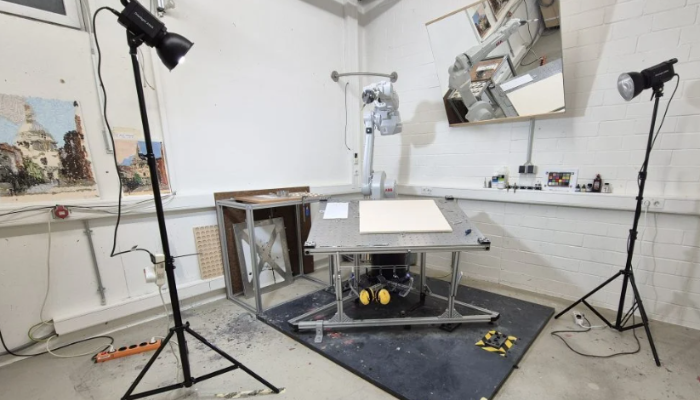
During my residency, I worked with e-David, a robotic painting system developed by Professor Oliver Deussen’s team. It uses cameras and algorithms to observe a painting in real time and adjust brushstrokes based on feedback. This system doesn’t rely on pre-programmed routines, but rather calculates, re-evaluates, and executes each stroke based on visual data.
Even with these advancements, tasks that take a human artist seconds—like filling a small canvas gap—can take the robot up to 15 minutes.
Why Robotic Painting Is So Hard
Painting involves a range of micro-movements, precision, and sensory feedback. A robot must know if it picked up enough paint, if the brush is bent, or if the paint is too wet. A small error can lead to repeated failures in a task we humans consider effortless.
Creating a digital image is one thing; physically rendering it with paint is another challenge altogether. Each brushstroke must be converted from an algorithmic decision into a mechanical action—a process filled with unpredictable outcomes.
Human-Robot Collaboration Is Key
The project’s true value lies in the back-and-forth between human and machine. In our painting series, each canvas is alternately painted by the robot and then by me, with each version modifying the last. Mistakes become new features, and the interaction itself evolves.
Rather than calling the robot an artist, it’s more accurate to think of it as a new kind of brush—an extension of the human creator.
Beware the AI Art Myth
Saying “a robot painted this” oversimplifies a very complex process. If we ignore the role of human programmers, assistants, and artistic input, we risk overestimating the autonomy of these machines. This distortion shapes public opinion, policy, and funding in dangerous ways.
The Future Is Collaborative, Not Autonomous
The excitement around AI art shouldn’t ignore the hard truth: robotic painting is hard. That difficulty is what makes it fascinating. Real innovation happens not when machines replace humans, but when we co-create—using machines to push boundaries, not replace creativity.