
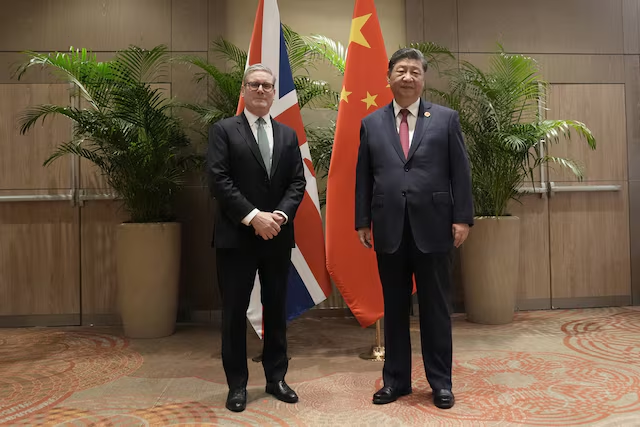
Starmer in Beijing: A Diplomatic Reset
British Prime Minister Keir Starmer visited China this week, the first UK prime minister to do so in eight years. He met President Xi Jinping at the Great Hall of the People. On the surface, the visit focused on trade talks, visa relaxations, and supporting Britain’s post-Brexit economy.
China, however, sees this as more than diplomacy. Beijing views it as a smart move in global politics. China wants to appear stable while the U.S. faces unpredictable leadership under President Donald Trump.
A Series of Western Visits
Starmer’s visit is part of a wave of Western leaders traveling to Beijing. French President Emmanuel Macron, Canadian Prime Minister Mark Carney, South Korean officials, the Irish Taoiseach, and Finnish representatives visited recently.
Carney’s visit led to a “new strategic partnership” and billions in trade deals. Trump responded by threatening 100% tariffs on Canada. Germany’s Chancellor is expected next month. These visits show Europe’s growing interest in China as U.S. trade policies cause tension.
China’s Larger Strategy
China sees Starmer’s visit as a way to weaken Western unity. Trump’s tariffs on allies give Beijing an opening to appear reliable.
Starmer avoided picking sides between the U.S. and China. He wants a practical relationship that balances security concerns and economic growth. For Xi, this strengthens China’s message of a world with multiple powers where Beijing sets the pace.
Historical Context: From Golden Era to Ice Age
UK-China relations have a long history. The 19th-century Opium Wars led to British control of Hong Kong. Beijing still recalls this as part of its national revival.
In 1997, Hong Kong was handed back to China. The 2015 “Golden Era” began when Prime Minister David Cameron hosted Xi in the UK. Sharing fish and chips and issuing RMB bonds strengthened ties. Over a million Chinese students in the UK also built cultural connections, such as Bowei Wang’s Glasgow-brewed ale now served in Beijing.
Relations cooled under Theresa May due to Huawei’s 5G ban, Hong Kong’s security law, human rights concerns in Xinjiang, and espionage claims. Starmer inherits this “ice age” but seeks a thaw, approving China’s new embassy in London before his visit.
Global Impact: Europe and Indo-Pacific
The visit affects global alliances. In Europe, Macron’s call for a world with multiple powers shows China is trying to pull allies from U.S. influence. Starmer’s revival of UK-China business talks may inspire similar moves in Germany and France.
In the Asia-Pacific, the visit challenges U.S.-led alliances like AUKUS and the Quad. China controls 90% of rare earths and dominates green technologies. Land corridors through Iran and Syria bypass U.S.-controlled sea routes. Investments in the Global South create a counterbalance to Washington.
Economic Stakes: Trade and Dependence
UK-China trade reached £93 billion in 2025. Britain exported £30 billion, down 23% from the previous year, and imported £63 billion, leaving a £33 billion deficit. Starmer’s visit brought benefits: 30-day visa-free travel for Brits, halved tariffs on Scotch whisky, and a $15 billion AstraZeneca investment in China through 2030.
These deals boost services, agri-food, healthcare, and auto trade, possibly adding £1 billion in UK value. For China, the goal is to secure export markets despite U.S. tariffs. Its strategy includes sending subsidized goods to Europe, which may pressure UK industries like energy.
Dependencies remain. China could use rare earths to gain leverage, while UK firms benefit from green technology projects. Trump called UK-China deals “very dangerous,” echoing previous warnings to Canada.
Looking Ahead: A Thaw With Risks
Starmer’s visit does not restore the Golden Era. China now produces a third of global goods. The visit is a careful balancing act that could reshape alliances.
Xi’s position is stronger after the U.S.-China trade truce in October 2025. For the UK, the visit promises growth. For the world, it tests the stability of a multipolar order. Will the thaw last under Trump’s tariffs? The global chessboard is watching.
Expert Quotes
“Starmer’s approach reflects a careful balancing act. Britain is no longer forced to choose between Washington and Beijing,” says Dr. Helena Roebuck, a China-UK relations expert.
“China sees these visits as proof of its role as a global conductor, setting the pace while the U.S. struggles,” notes geopolitics analyst Mark Chen.