
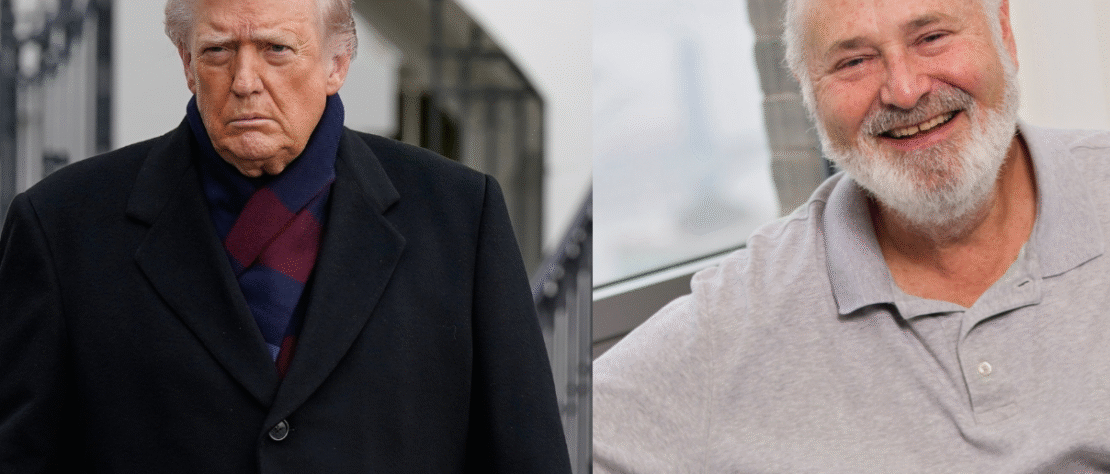
The political and cultural worlds in the United States erupted in condemnation on Monday after President Donald Trump issued a controversial social media post following the deaths of acclaimed Hollywood director Rob Reiner and his wife, Michele Reiner. Trump’s remarks, which appeared to attribute Reiner’s death to his longstanding criticism of the president, were widely denounced by lawmakers and celebrities across party lines as cruel, inappropriate, and deeply offensive.
Reiner, 78, best known for directing classics such as When Harry Met Sally, The Princess Bride, and A Few Good Men, and his 68-year-old wife were found dead in their Brentwood, Los Angeles home on Sunday. Authorities later confirmed that the couple’s 32-year-old son, Nick Reiner, had been arrested on suspicion of murder. His bail was set at $4 million.
Rather than offering condolences, Trump took to social media shortly after news of the deaths emerged, using the moment to attack Reiner personally and politically. In his post, the president described the director as “tortured and struggling” and claimed Reiner had died “due to the anger he caused others” through what Trump labeled an “incurable affliction” he referred to as “Trump Derangement Syndrome.”
Trump’s statement went on to portray Reiner as consumed by hatred and obsession, contrasting the director’s alleged mental state with what the president described as the success of his own administration. Trump praised himself for having “surpassed all goals and expectations of greatness,” declaring that the United States was experiencing a “Golden Age of America, perhaps like never before.”
The backlash intensified hours later when Trump doubled down on his comments during an unrelated White House event. Asked by a reporter about the controversy, the president mocked Reiner again, saying, “I wasn’t a fan of his at all. He was a deranged person as far as Trump is concerned.”
Trump further claimed that Reiner had spread false allegations about him, including claims related to Russia, which Trump once again dismissed as a “hoax.” He suggested that Reiner’s outspoken criticism had damaged the director’s career and mental health.
“These remarks are beyond the pale,” critics said, noting that the comments were made while details of the deaths were still emerging and a family tragedy was unfolding.
Swift Condemnation Across Politics and Entertainment
Reaction to Trump’s comments was swift and fierce. Actor Patrick Schwarzenegger described the president’s remarks as “disgusting and vile” in a post on X, echoing the outrage expressed by many in Hollywood.
Television host Whoopi Goldberg, who described Reiner as both a friend and “an amazing man,” delivered one of the most pointed rebukes. Drawing a comparison to Trump’s previous statements condemning political violence after the killing of far-right activist Charlie Kirk earlier this year, Goldberg questioned the president’s sincerity.
“I don’t understand the man in the White House,” Goldberg said. “He spoke at length about compassion, and then this is what he puts out. Have you no shame? No shame at all? Can you get any lower?”
California Governor Gavin Newsom condemned Trump in stark terms, writing simply on X: “This is a sick man.”
Democratic lawmakers followed suit. Florida Representative Maxwell Alejandro Frost called Trump’s comments “despicable,” while Connecticut Senator Chris Murphy said the president had “lost it,” accusing him of effectively blaming the victims for their own deaths.
“This is a family tragedy, and the president is turning it into a political attack,” Murphy said.
California Representative Zoe Lofgren described the remarks as “a new low for this petty, hateful man,” urging Republican leaders to publicly condemn Trump’s behavior.
Rare Bipartisan Rebukes
Notably, criticism also came from members of Trump’s own party. Georgia Representative Marjorie Taylor Greene acknowledged the political differences many had with Reiner but stressed that the moment demanded empathy rather than attacks.
“This is a family tragedy, not about politics or political enemies,” Greene wrote, adding that many families struggle with addiction and mental health issues and that such situations should be met with compassion, particularly when they end in violence.
Kentucky Representative Thomas Massie echoed that sentiment, calling Trump’s comments “inappropriate and disrespectful.”
“Regardless of how you felt about Rob Reiner, this is not acceptable,” Massie said, adding that he challenged fellow Republicans including Vice President JD Vance and White House officials—to defend the president’s remarks.
A Vocal Trump Critic Remembered
Reiner had long been one of Trump’s most outspoken critics in Hollywood. In a 2017 interview with Variety, he described Trump as “mentally unfit” for office. He later warned that the United States risked sliding into autocracy if Trump returned to power, a concern he shared in interviews with the Guardian ahead of the 2024 election.
“We see autocracy making its move around the world,” Reiner said at the time. “If the US crumbles, democracy around the world could crumble with it.”
Despite his fierce political criticism, Reiner was also a vocal opponent of political violence. Following the killing of Charlie Kirk in September, Reiner unequivocally condemned the act.
“That should never happen to anybody,” he said then. “I don’t care what your political beliefs are. Violence is not a solution.”
Personal and Historical Ties to Trump
Adding a striking historical footnote to the tragedy, Reiner’s wife Michele was the photographer who shot the iconic cover image for Trump’s 1987 book The Art of the Deal. Reiner had previously recounted the story in interviews, describing Trump’s concern over his appearance during the photo shoot atop a Manhattan high-rise.
The connection has underscored for many critics the irony of Trump’s remarks, highlighting the deeply personal and intertwined histories now overshadowed by a moment of public outrage.
As investigations into the deaths continue, calls for restraint and empathy have grown louder. For many observers, Trump’s comments have not only reignited debates about political rhetoric and decorum but also raised broader questions about leadership, compassion, and responsibility in moments of national tragedy.