
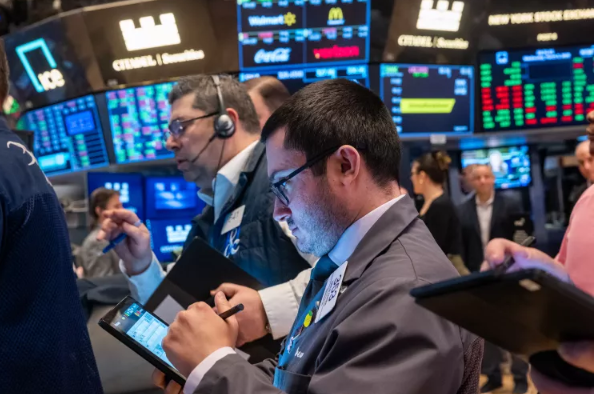
U.S. Stocks Drop Amid Uncertainty Over Trump’s Tariffs and Fed Policy
U.S. stock markets closed lower on Tuesday, halting a two-day rally, as investors braced for the Federal Reserve’s upcoming monetary policy announcement and wrestled with concerns over President Donald Trump’s tariff plans. The Dow Jones Industrial Average fell 260.32 points (0.62%) to 41,581.31, the S&P 500 shed 60.46 points (1.07%) to 5,614.66, and the Nasdaq Composite dropped 304.55 points (1.71%) to 17,504.12.
The Fed’s next policy statement, due Wednesday, is expected to keep interest rates steady while unveiling its updated economic projections (SEP). Markets are betting on roughly 60 basis points of rate cuts in 2025, but Fed officials have urged caution, emphasizing the need to assess tariff impacts on economic data before acting. “There’s huge uncertainty around tariffs—how broad they’ll be, their economic fallout, and how much the Fed might ease,” said Tim Ghriskey, senior portfolio strategist at Ingalls & Snyder in New York. “Confusion breeds fear when there’s no clear path for stocks or corporate growth.”
Tariff Jitters and Inflation Pressures Weigh In
Trump’s tariff rhetoric has rattled markets, with investors unsure of the scale and scope of potential trade policies. Adding fuel to inflation worries, U.S. import prices rose unexpectedly in February due to pricier consumer goods. After weeks of declines that pushed the S&P 500 and Nasdaq into correction territory (down over 10% from recent peaks), stocks had shown signs of steadying—until Tuesday’s pullback. The Dow remains just over 2% shy of its own correction threshold.
Growth stocks bore the brunt of the sell-off, with the S&P 500 Growth Index plunging as much as 2.2%. Communication services, down 2.14%, led losses among the S&P’s 11 sectors. Meanwhile, safe-haven assets like gold hit a record high above $3,000 per ounce, reflecting a defensive shift among investors.
Market Movers: Tech Titans Stumble
Major tech stocks stumbled, amplifying the downturn. Alphabet (Google’s parent) slid 2.2% after announcing a $32 billion acquisition of cybersecurity firm Wiz—its largest deal yet. Nvidia dropped 3.35%, despite CEO Jensen Huang’s optimism about the chipmaker’s role in AI’s evolving landscape. Tesla took a sharper hit, tumbling 5.34% after RBC slashed its price target from $320 to $120, citing weaker prospects for full self-driving tech and robotaxi dominance. Tesla’s stock is now down nearly 45% year-to-date.
Geopolitical Twists and Market Mood
In a separate development, the White House revealed that Trump and Russian President Vladimir Putin agreed to a 30-day ceasefire in Ukraine, targeting energy and infrastructure attacks, with peace talks set to begin immediately. While not directly tied to Tuesday’s market moves, the news added another layer of complexity to an already jittery global outlook.
By the Numbers
The NYSE saw decliners outpace advancers 1.69-to-1, while the Nasdaq’s ratio hit 1.93-to-1. The S&P 500 logged four new 52-week highs and four lows, while the Nasdaq recorded 32 highs and 142 lows. Trading volume reached 13.40 billion shares, below the 20-day average of 16.41 billion.
What’s Next?
With the Fed’s decision on deck and tariff uncertainty clouding the horizon, Wall Street remains on edge. Investors are left parsing mixed signals—cautious Fed commentary, inflationary pressures, and Trump’s trade agenda—setting the stage for potential volatility in the days ahead.